Day 2: Microsimulation Modeling
Learning objectives
By the end of Day 2, participants should be able to:
- Understand implementation differences between microsimulation and cohort state transition models
- Understand how to summarize the output from a microsimulation model
- Understand how to incorporate more complex dependencies and dynamics in a microsimulation model
- Implement a microsimulation in R
- Understand how to convert a decision analytic model from an R script to an R function
Day 2 schedule
| Time | Material |
|---|---|
| 10:00am-10:15am | Review of Day 1 material |
| 10:15am-10:45am | Making your model a function: How and why |
| 10:45am-12:00pm | Code walk through: Microsimulation 3-state model |
| 12:00pm-12:30pm | Lunch |
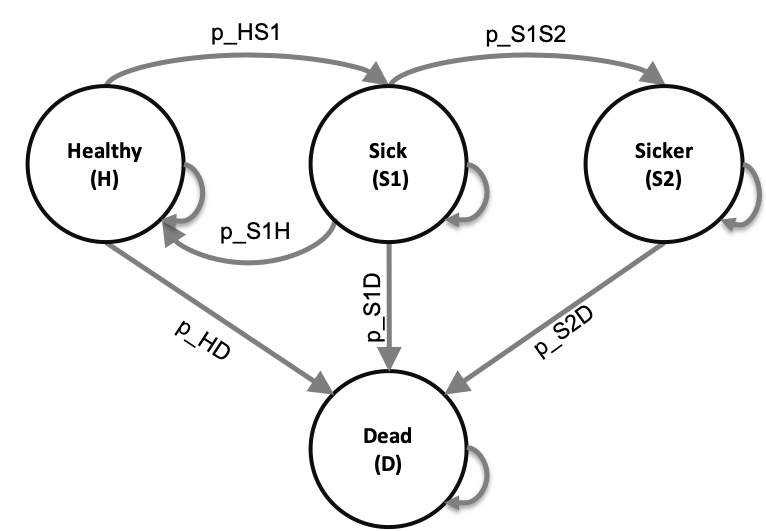
| 12:30pm-2:00pm | Hands-on exercise: Code your own microsimulation model with Sick-Sicker example |
| 2:00pm-4:00pm | Advanced topics - TBD |
Materials
Download slides: Microsimulation modeling in R
Download R code demo & walkthrough - Make your model a function
Download R code demo & walkthrough - 3-state microsimulation
Exercise - Sick-Sicker microsimulation with time dependency
Download data: ‘mortProb_age.csv’